
As March begins to give way to April, the farm enters one of the most hopeful times of the year.
This season is always filled with a sense of anticipation. The final days of winter are behind us, the light lingers a little longer each evening, and signs of spring begin to appear across the farm. While our open fields are just starting to awaken, the growing season is already underway in our high tunnels and greenhouses, where the first crops of spring are taking shape.
This time of year also carries special meaning as we recognize both Women’s History Month and Women in Ag Month—a chance to reflect on the women whose work has shaped agriculture across generations. From trailblazers like Elizabeth Coleman White, who helped establish New Jersey’s blueberry industry, to food science pioneer Mary Engle Pennington, women have long been integral to how we grow, preserve, and share food.
That legacy continues here on our farm every day.
The women on our team contribute across every aspect of farm life—from greenhouse growing and field work to member services, retail operations, and guest experiences. Their dedication, knowledge, and care help shape not only the crops we grow, but also the connection our community feels to the land and to one another.
Spring is often seen as a beginning, but on the farm it is also a continuation of thoughtful work that never truly stops. Long before the first outdoor harvest, our team is already tending seedlings, preparing beds, and nurturing the crops that will mark the start of the season.
Inside our greenhouses and high tunnels, rows of tender greens and fragrant herb plants are already thriving. These spaces play an important role in extending the season, allowing us to begin growing earlier and provide fresh harvests even while the weather outside is still unpredictable. More than a practical tool, they reflect our broader philosophy of farming in rhythm with nature.
At the heart of this philosophy is agroecology.
Agroecology is about seeing the farm as a living ecosystem, where every element—from soil microbes and pollinators to crops and people—works together as part of a larger whole. It is a way of farming that values long-term health over short-term output, focusing on stewardship, biodiversity, and resilience.
Rather than relying solely on conventional inputs, we work to build fertility from the ground up through practices like composting, crop rotation, cover cropping, and careful soil stewardship. Healthy soil is the foundation of everything we grow. It retains water more effectively, supports stronger root systems, fosters beneficial organisms, and helps produce nutrient-rich crops. By supporting pollinators and encouraging biodiversity across the farm, we help create natural balance and strengthen the resilience of our fields and growing spaces.
This approach is especially meaningful as we enter spring. The first harvests of the season are not simply products of warmer weather, but the result of months of planning, soil care, and regenerative practices that begin long before anything is picked.
As we move into April, one of the most beloved milestones of the season is just around the corner: the start of our CSA.
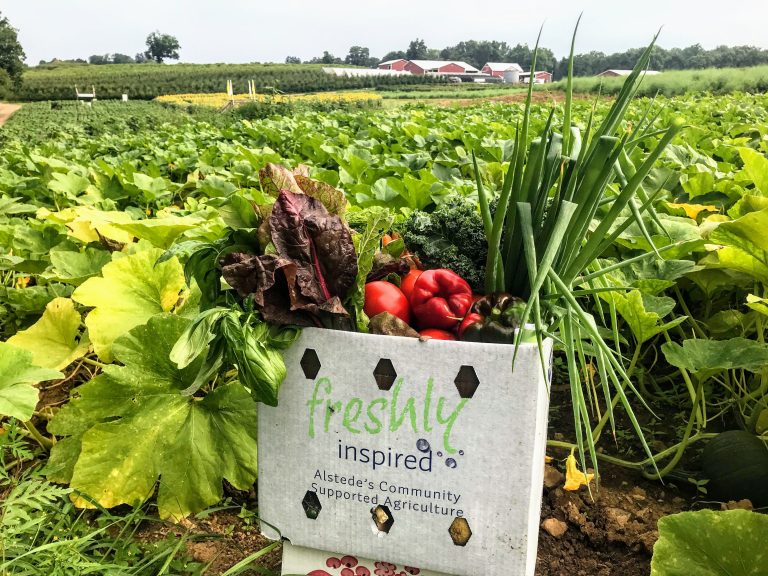
Beginning at the end of April, our CSA marks the true arrival of spring for many of our members. There is something deeply special about that first box of the year—the first fresh greens, the first herbs, the first taste of the season ahead.
Already, herb plants are growing in our greenhouses for CSA members, a cherished and familiar sign that the farm is coming back to life. These early offerings are often among the most beloved, bringing the fragrance and freshness of spring into kitchens after the long winter months.
Early shares typically reflect the best of what the season offers first: fresh greens, spinach, asparagus, herbs, and other crops harvested from our protected growing spaces. As the weeks unfold, the boxes evolve with the landscape itself, changing naturally as the season progresses and inviting members to eat in step with the rhythms of the farm.
That seasonal connection is one of the most meaningful parts of the CSA experience.
It is more than a weekly box—it is a relationship with the land, with the people who grow the food, and with the natural pace of the seasons. It is a reminder that food is not static, but something living and changing, shaped by weather, soil, and time.
As we step into April and the farm begins its busiest and most beautiful season, we are grateful for the people who make this work possible and for the community that supports it.
Every share, every visit, and every meal prepared with food from the farm is part of something larger: a commitment to local agriculture, to regenerative stewardship, and to a more connected food system for the future.


